Beyond the Click: How Creator Partnerships Build Real Brand Equity
In 2026, brand equity isn't about how many people recognize your brand. It's about the depth of trust you hold and content creators are the ultimate shortcut to both.
Let's start with a question most brands are afraid to ask: If you stopped running ads tomorrow, would anyone remember your business? For a lot of companies, the honest answer is no. Because what they've been buying is attention not trust. Visibility not value. And those two things are not the same.
Brand equity is the premium your market is willing to pay, the loyalty that outlasts a sale, the cultural relevance that keeps you in the conversation long after the campaign budget runs dry. It's the difference between a brand people choose and a brand people settle for.
And one of the most powerful, underutilized tools for building it? Content creators.
A creator campaign might end in 30 days. But the high-quality content and the social proof it generates? That stays in the digital ecosystem longer than an ad contributing to your brand's value. When someone is trying to learn more about your product, they seek out social proof like reviews and content. People are more likely to believe a content creator over an ad.
The Three Pillars of Creator-Led Brand Equity
Not all creator partnerships are created equal. Done right, they work on three distinct levels each one compounding on the last.
⚡
01 Speed-to-Trust (The Halo Effect)
Building brand equity the traditional way takes years of consistent messaging, product excellence, and cultural consistency. Creators compress that timeline dramatically. When a creator who has spent years earning the trust of their audience advocates for your brand, something powerful happens: their community transfers their positive feelings for that person directly onto your brand.
This is the halo effect in action. You don't earn that trust from scratch; you borrow it. And from the audience's perspective, the endorsement carries the weight of a personal recommendation, not a paid placement. The result is higher perceived quality and reliability, almost immediately. When I am seeking out a content creator to work with, I look into their past work and how their audience reacts to the sponsored post. Most viewers like when the creator is cautious about who they work with as to not wanting to scam their viewers. I my next post is all about trust and relationship building so consider following me on Substack Well crafted branding | Substack
THE LOGIC Audiences trust creators they follow the way they trust a knowledgeable friend — often more than they trust ads. With the rise of AI, it is having an effect on consumer confidence.
THE RESULT
Accelerated credibility. Your brand arrives in front of new audiences pre-approved. With a creator who cares about their audience and doesn't want to face backlash, they are more cautious about who they work with. This creates that level of brand equity because the influencer has a stake in the brand by promoting it creating more social proofing.
02 — Contextual Relevance
Generic ads feel intrusive because they are. They interrupt. Creator content, by contrast, embeds your brand inside a world the audience already wants to live in. When a creator features your kitchen product in their Sunday meal prep video, it doesn't look like advertising it looks like a lifestyle moment you happen to be part of.
That context is doing serious heavy lifting for your brand. It's making the emotional connection between your product and a specific aspiration, habit, or identity. Over time, that kind of placement doesn't just generate sales it makes your brand synonymous with a way of living. That is brand equity.
THE LOGIC Seeing a product used authentically in context feels like a recommendation, not a pitch and that's exactly the power of influencer marketing. When a creator your audience already trusts puts your product in their hands, you're not interrupting their feed. You're being vouched for.
That borrowed trust is what makes the real strategic play possible: use the influencer to build awareness, then retarget their audience with ads designed to convert. By the time someone sees your paid ad, they've already had a trust touchpoint. You're not selling to a cold audience you're closing a warm one.
This sequence matters because it changes the entire conversion environment. Influencers do the expensive work of earning attention and credibility. Paid ads do the efficient work of following up. Together, they stretch your budget further and lower your cost per acquisition because warm audiences convert faster, at higher rates, and with less friction.
It's not just a smarter way to spend. It's how you make every marketing dollar work twice.
THE RESULT Your brand becomes associated with a lifestyle or solution not just a transaction.
03 — Humanizing the Narrative
People don't bond with corporations. They bond with stories, with voices, with faces. Brand equity relies heavily on emotional connection, and that's exactly what most sterile brand identities fail to create on their own. Creators bring the human element your content strategy is probably missing.
They translate your brand's values into lived experience. They add warmth, humor, vulnerability, and personality the things that make a brand feel real rather than manufactured. And the way an audience feels about your brand, what marketers call brand sentiment, is one of the core components of long-term equity.
THE LOGIC People bond with stories and voices. Creators provide what corporate branding can't: genuine humanity. There is a shift in how some brands are creating more web series that are doing well in generating more followers and engagement. Not all brands want to put in the money to produce content similar to what a content creator produces.
THE RESULT Improved Brand sentiment how people feel about you is what turns customers into loyal advocates long after the sale. It's one of the most valuable assets a brand can build, and one of the hardest to fake.
Growing it organically through content is a legitimate path, but it's a slow one. A faster way to move the needle is through creator partnerships. When a trusted voice in your space genuinely engages with your brand, their audience takes notice and that positive association transfers. You're not just picking up followers or engagement. You're inheriting credibility.
The right partnership doesn't just expand your reach. It shapes how people feel about you before they ever buy.
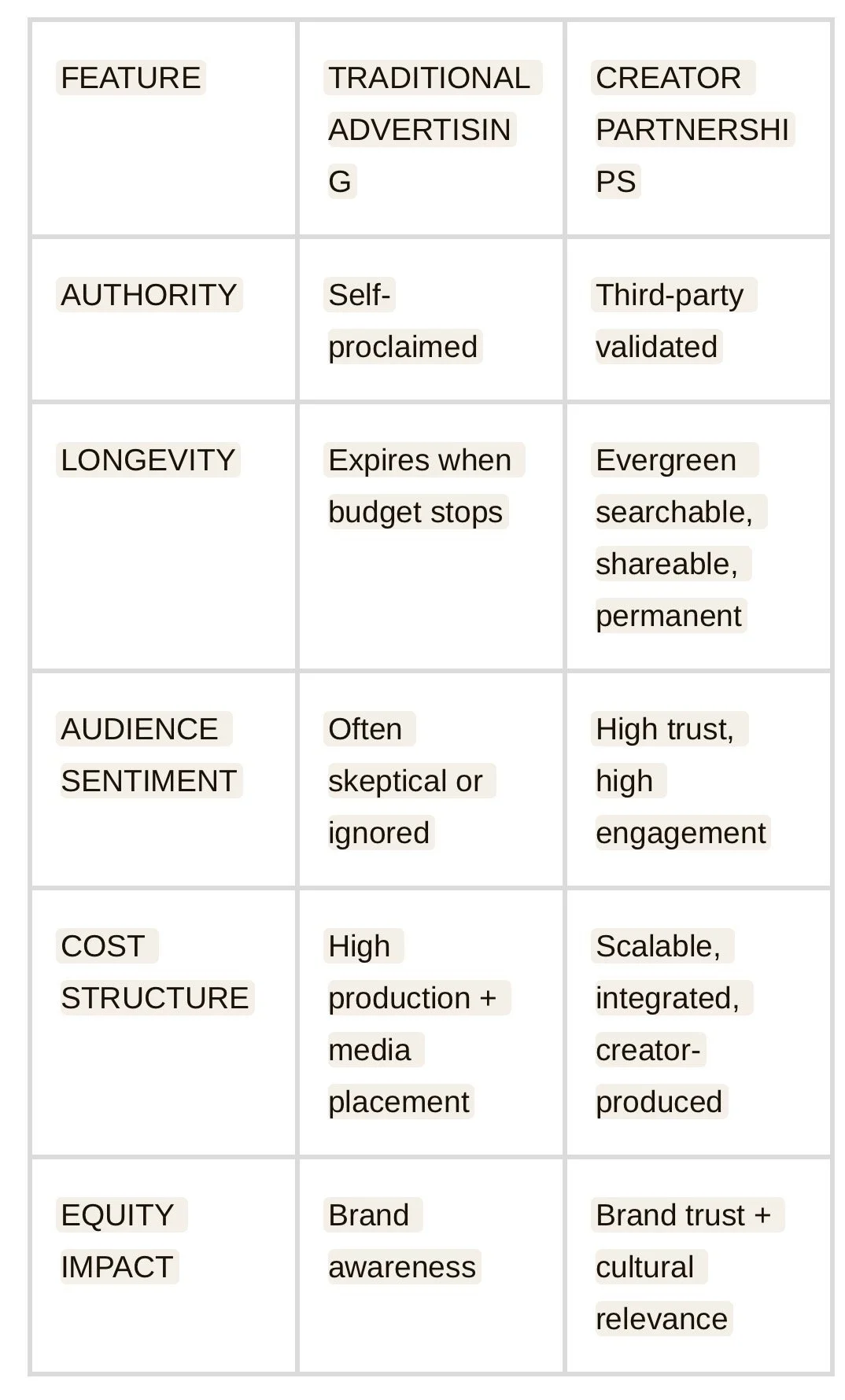
Traditional Ads vs. Creator Partnerships
This isn't an argument that traditional advertising is dead. It isn't. But it's important to be honest about what each approach actually builds, and over what timeline.
SIDE-BY-SIDE COMPARISON
Think Equity, Not Just Sales
Here's the mindset shift that separates brands that grow from brands that grind: sales are what happen this quarter. Equity is what happens over the next five years.
Brand equity is what allows you to charge a premium price. It's what keeps customers coming back even when you're not running a promotion. It's what makes people choose you in a crowded market, not because you were the cheapest or the loudest, but because they trust you.
THE LONG GAME
When you invest in creator partnerships with an equity mindset, you're not just buying impressions. You're building permanent digital real estate content that lives on search, on social, in saved posts and shared links, long after the campaign is technically "over." That's not a media spend. That's an asset.
The brands that understand this aren't asking "What's our cost per click?" They're asking "What does this do for how our market perceives us six months from now?" Those are fundamentally different questions — and they lead to fundamentally different results.
Where to Start
If you're new to creator strategy, the temptation is to go big immediately high follower counts, broad reach, splashy campaigns. Resist it. The highest-equity partnerships are often with mid-tier or niche creators whose audiences are highly specific and deeply engaged. A 40,000-follower creator whose audience is exactly your customer is worth more than a million-follower account that talks to everyone and no one at once.
Start by asking: Who has already built trust with the exact person I'm trying to reach? Then build from there. Think about alignment of values, not just aesthetics. Think about content longevity is this creator producing work that will still be findable and relevant in 18 months? And think about the story. What does this partnership say about who your brand is?
Done well, a single authentic creator partnership can do more for your brand equity than six months of paid advertising. The math, the trust, and the longevity all point in the same direction.
The only question is whether you're willing to play the long game.
KEY TAKEAWAYS
Trust transfers — creator audiences extend their loyalty to endorsed brands
Context builds relevance, not just awareness
Human storytelling creates emotional equity that ads can't buy
Creator content is evergreen; ad spend is not
Equity = premium pricing power + long-term loyalty
ABOUT THIS POST
Written by Well Crafted Branding, a California-based branding, marketing, and PR agency serving small businesses and personal brands across the US, Canada, and UK.
FILED UNDER
Influencer Strategy
Brand Equity
Content Marketing
Creator Economy
